Official Google Processing Timelines: Direct Answer
Google’s reported typical end-to-end indexing time is approximately 1.5 hours, while new URL discovery takes around 20 hours. Core update recovery typically takes 3 to 6 months, with these figures serving as reference ranges rather than guaranteed deadlines.
Gary Illyes presented the timing ranges at Search Central Live Deep Dive Europe in Barcelona. Search Engine Journal reported them through an attendee recap by John Campbell of ROAST, which attributed the figures to Google’s internal analysis.
The main warning concerns how these processes connect: Google must crawl a page before indexing it. A delay early in that sequence carries into subsequent stages, postponing indexing and eventual serving in search results.
That distinction matters when reading the figures below. The 1.5-hour indexing benchmark should not be treated as a promise that a newly published page will appear in search within 90 minutes. Discovery has its own reported timeframe.
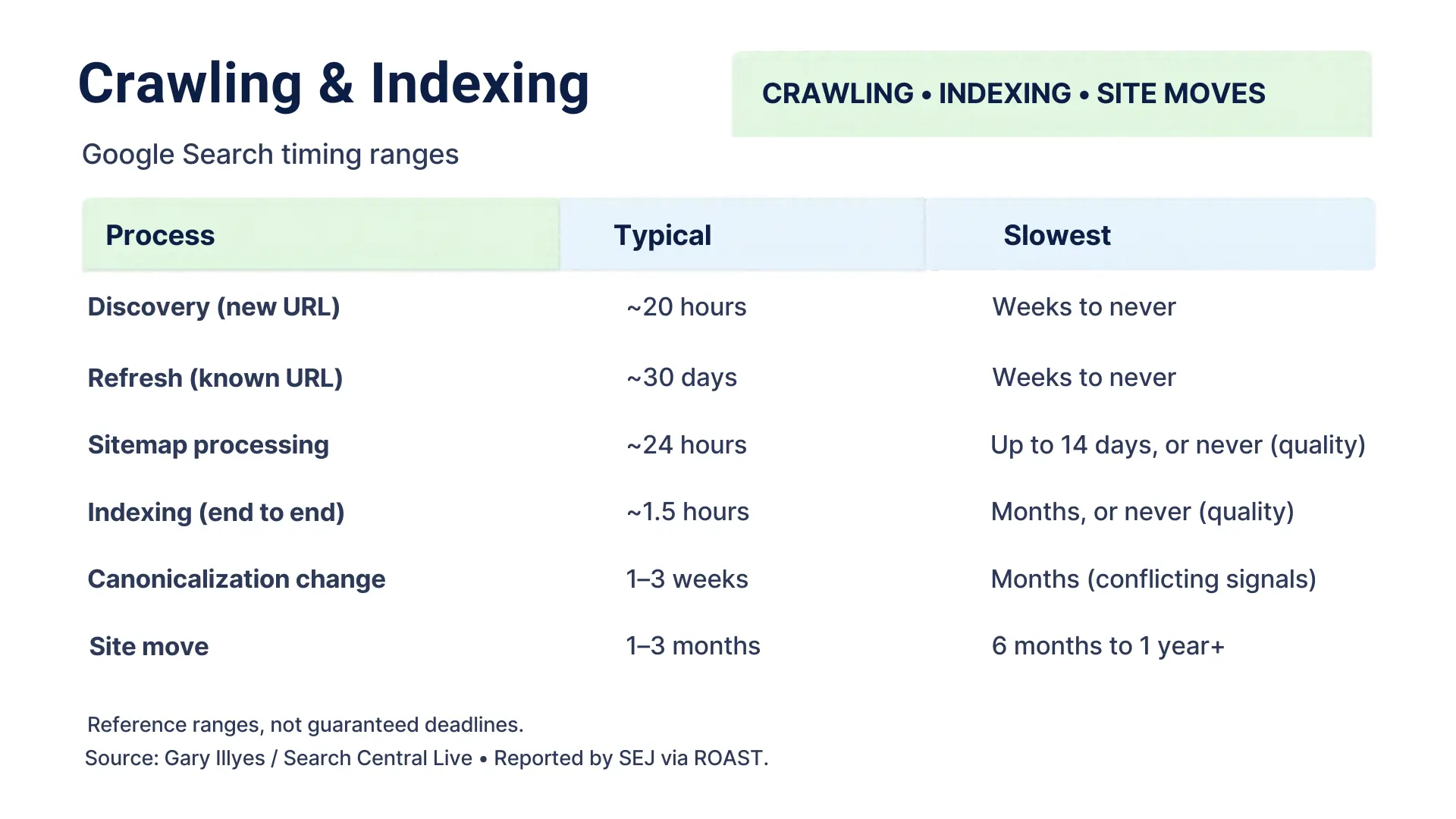
Crawling & Indexing Benchmarks
DISCOVERY: NEW URL
- Typical: Approximately 20 hours
- Slowest: Weeks to never
Discovery is a separate benchmark from end-to-end indexing. Keep both stages in view when assessing a new page.
INDEXING: END TO END
- Typical: Approximately 1.5 hours
- Slowest: Months, or never due to quality
This figure concerns successful completion of the critical indexing processes. The slowest range includes cases where indexing never happens.
REFRESH: KNOWN URL
- Typical: Approximately 30 days
- Slowest: Weeks to never
Refreshing a URL Google already knows has a different reported timeframe from discovering a new one.
SITEMAP PROCESSING
- Typical: Approximately 24 hours
- Slowest: Up to 14 days, or never due to quality
Treat this as the sitemap-processing range, rather than a deadline for every listed URL to become indexed.
CANONICALIZATION CHANGE
- Typical: 1-3 weeks
- Slowest: Months with conflicting signals
The reported slowest case specifically identifies conflicting signals as a complication.
Search Results, Moves & Core Recovery
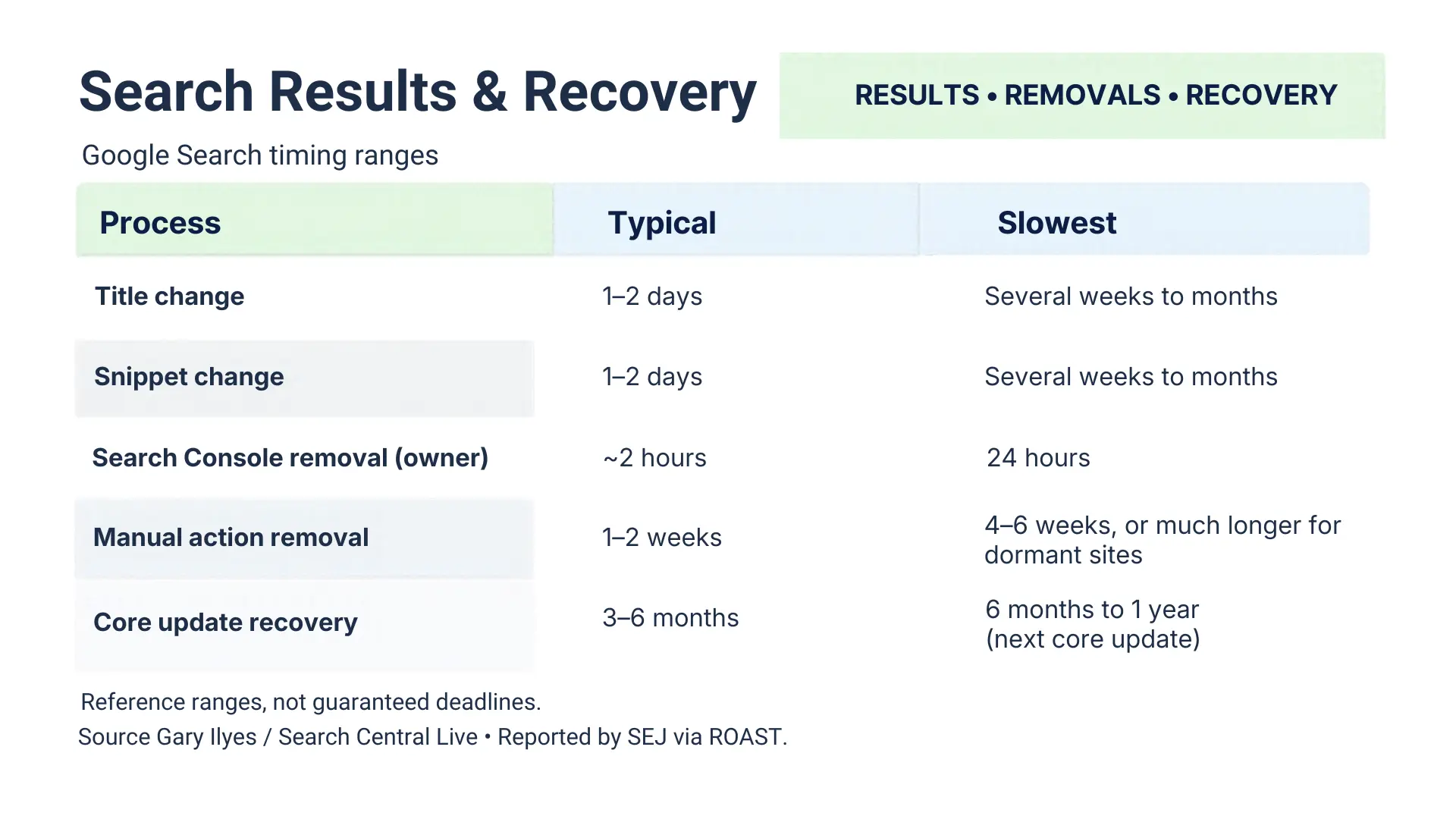
TITLE & SNIPPET CHANGES
- Typical: 1-2 days
- Slowest: Several weeks to months
Both changes have the same reported range, although they are listed as separate processes in the source.
SEARCH CONSOLE REMOVAL: OWNER REQUEST
- Typical: Approximately 2 hours
- Slowest: 24 hours
MANUAL ACTION REMOVAL
- Typical: 1-2 weeks
- Slowest: 4-6 weeks
- Additional qualification: Much longer for dormant sites
SITE MIGRATION
- Typical: 1-3 months
- Slowest: 6 months to 1 year or longer
Use the migration range when discussing a site move, rather than applying the much shorter indexing benchmark.
CORE UPDATE RECOVERY
- Typical: 3-6 months
- Slowest: 6 months to 1 year, associated with the next core update
These figures describe recovery, not how long a core update takes to roll out.
Key Takeaways for SEO Strategy
Identify the process before estimating the wait. Discovery, indexing, refreshes, search-result changes and recovery have distinct ranges. Combining them into one universal “Google processing time” would misrepresent the data.
“Never” is part of several slowest cases. Quality is explicitly mentioned for sitemap processing and indexing. Waiting longer therefore does not guarantee completion.
Use ranges when setting expectations. The source does not define “typical” or disclose the sample size or measurement period. These figures support planning and progress discussions, but they are not fixed deadlines or guarantees.
Source: https://www.searchenginejournal.com/google-crawling-indexing-recovery-timing-ranges/591829/