People no longer find information only through traditional search results. They also discover information through featured snippets, Google AI Overviews, AI assistants, maps, videos and other search experiences. This has introduced several new terms, including AEO, GEO and SXO.
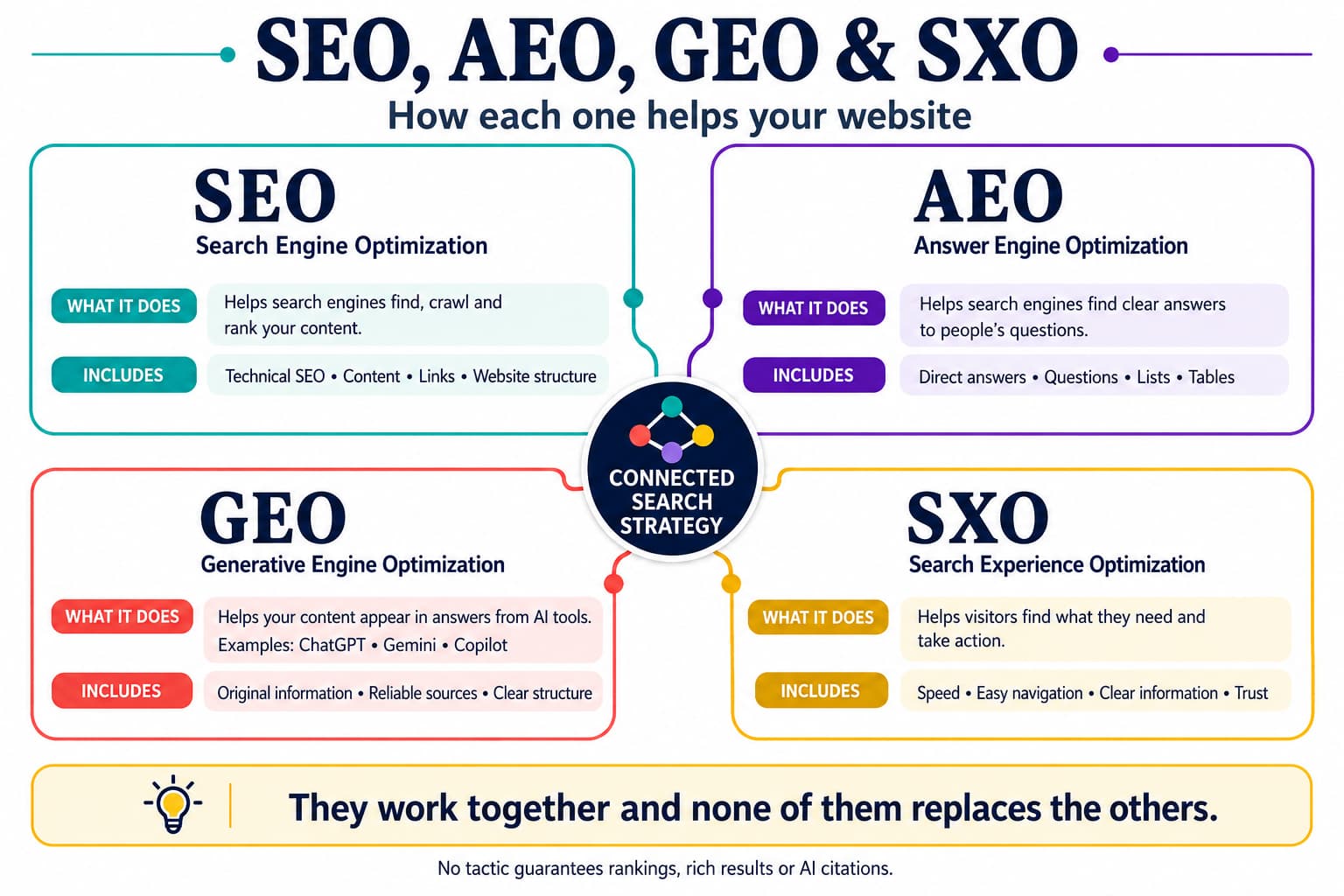
They are often presented as separate “layers” of optimization. In practice, however, they overlap significantly. SEO remains the foundation, while AEO, GEO and SXO focus on different parts of how content is discovered, understood, presented and used.
Understanding the difference can help businesses improve their visibility without chasing every new marketing acronym.
SEO: Building the Foundation for Search Visibility
SEO, or Search Engine Optimization, helps search engines discover, understand and appropriately display website content.
Its goal is not simply to publish a page and get it indexed. Effective SEO aims to attract relevant visitors who are genuinely interested in the information, products or services a website provides.
SEO usually includes:
- Technical accessibility and crawlability;
- Correct indexing and canonicalization;
- Website structure and internal linking;
- Search intent and keyword research;
- Helpful, accurate and original content;
- Page titles, headings and meta descriptions;
- Relevant structured data;
- Page speed and mobile usability;
- Relevant backlinks and brand mentions;
- Local search optimization where applicable.
Google describes search as a process involving crawling, indexing and serving results. However, meeting the technical requirements does not guarantee that a page will be indexed or rank prominently.
The same applies to structured data. Schema markup can help search engines understand a page and may make it eligible for certain rich results, but it does not guarantee higher rankings or enhanced search appearances.
Better SEO success metrics
Rankings and organic traffic still matter, but they should not be evaluated in isolation.
More meaningful SEO metrics include:
- Organic clicks from relevant searches;
- Non-branded search visibility;
- Qualified organic traffic;
- Leads, bookings or sales from organic search;
- Conversion rate;
- Visibility for important commercial and informational topics.
A website can have thousands of indexed pages without attracting valuable traffic. For this reason, the number of indexed pages should normally be treated as a technical indicator rather than a primary measure of success.
AEO: Making Content Easier to Extract as an Answer
AEO stands for Answer Engine Optimization.
It focuses on presenting information in a way that makes clear answers easy for search engines and other answer-based systems to identify and display.
This can support visibility in:
- Featured snippets;
- People Also Ask results;
- Voice search responses;
- Search-generated answers;
- Some AI-powered search experiences.
AEO does not replace SEO, nor is it an independent ranking system. It is better understood as an approach to content structure and clarity.
Useful AEO practices include:
- Using real questions as headings;
- Providing a concise answer immediately after the question;
- Explaining the answer in greater detail below;
- Writing clear definitions;
- Using descriptive headings;
- Presenting steps as numbered lists;
- Using comparison tables where appropriate;
- Including relevant examples;
- Avoiding vague or unnecessarily complicated wording.
However, there is no guaranteed formula for earning a featured snippet or appearing in an AI-generated answer. The search engine decides which sources and formats are appropriate for each query.
FAQ schema should also not be treated as an AEO shortcut. Structured data can clarify the meaning of content when used correctly, but it does not guarantee that a page will receive a rich result or be selected as a direct answer.
Useful AEO success metrics
Depending on the website and available reporting, AEO may be evaluated through:
- Featured snippet visibility;
- People Also Ask appearances;
- Impressions for question-based searches;
- Clicks from long-tail informational queries;
- Visibility within relevant search features;
- Conversions assisted by informational content.
Zero-click visibility can create brand exposure, but visibility without traffic or business impact should not automatically be considered a complete success.
GEO: Increasing Visibility in Generative AI Answers
GEO stands for Generative Engine Optimization.
It focuses on improving the likelihood that content or a brand will be found, understood, referenced or cited by generative AI systems.
These systems may include:
- ChatGPT;
- Google Gemini and AI-powered Google Search features;
- Microsoft Copilot;
- Perplexity;
- Claude and other AI assistants with search or retrieval capabilities.
GEO is a real and developing area, but it does not yet have one universal set of rules. Different AI platforms use different models, indexes, retrieval systems and source-selection methods.
Google states that the existing SEO best practices remain relevant for AI Overviews and AI Mode. It also says that no special schema or additional technical optimization is required specifically for these features.
This means that strong GEO usually begins with strong SEO.
What can support GEO visibility?
Useful practices include:
- Publishing original research, analysis or first-hand experience;
- Supporting claims with reliable sources;
- Including accurate statistics with proper context;
- Showing clear authorship and relevant expertise;
- Keeping important information current;
- Creating focused and well-structured pages;
- Maintaining consistent business and brand information;
- Earning relevant mentions from trusted external websites;
- Using structured data that accurately represents visible page content;
- Ensuring that important content is accessible to search and AI crawlers;
- Providing clear information about products, services, people and locations.
Generative systems often need passages that can be understood outside the context of the entire page. This makes clear headings, direct explanations and self-contained sections particularly useful.
Original information can also give a page a stronger reason to be cited. Rewriting what already appears on dozens of websites may produce a readable article, but it does not necessarily create a distinctive or authoritative source.
Access for AI search crawlers
Technical access also matters.
For example, OpenAI uses OAI-SearchBot to identify and surface websites in ChatGPT search results. A website that blocks this crawler may not appear as a cited source in ChatGPT search answers.
This is separate from GPTBot, which is associated with the collection of content that may be used to improve generative AI models. Website owners can manage these crawlers separately through robots.txt.
Better GEO success metrics
AI visibility should be measured carefully. Useful indicators may include:
- Citations in AI-generated answers;
- The number of cited or referenced pages;
- Brand mentions in relevant AI responses;
- Referral traffic from AI platforms;
- Assisted conversions from AI-referred visits;
- Growth in branded searches;
- Visibility across relevant prompts and topics.
A citation does not automatically indicate authority, ranking position or business impact. It shows that the content was used or referenced in a particular AI experience.
Microsoft’s AI Performance reporting in Bing Webmaster Tools reflects this distinction. It can show citation activity and cited URLs, but Microsoft explains that citation counts do not necessarily represent ranking, authority or the importance of a page within an answer.
SXO: Turning Search Visibility Into a Useful Experience
SXO stands for Search Experience Optimization.
SEO, AEO and GEO can help a business become visible. SXO focuses on what happens when a person reaches the website.
A page may rank well and attract traffic but still fail to produce results if it is slow, confusing or difficult to use.
SXO can include:
- Fast loading times;
- Clear navigation;
- Mobile-friendly layouts;
- Readable content;
- Accessible design;
- Clear calls to action;
- Relevant landing pages;
- Transparent pricing or service information;
- Trust signals;
- Simple contact, booking or checkout processes;
- Consistency between the search result and landing page.
The objective is not to manipulate engagement signals. It is to make it easier for visitors to complete the action that brought them to the website.
Useful SXO success metrics
SXO is usually evaluated through business and user-behaviour metrics such as:
- Engagement with important page elements;
- Contact form submissions;
- Phone calls;
- Bookings;
- Purchases;
- Conversion rate;
- Checkout or form completion;
- Qualified leads;
- Revenue from organic visitors.
Sales and revenue should not be attributed to SXO alone. They are also affected by pricing, demand, reputation, the quality of the offer and the sales process.
Is AIO a Separate Type of Optimization?
AIO is sometimes used to mean AI Optimization.
The term is not as clearly established as SEO, and its meaning can vary between agencies and software providers. It often covers practices such as:
- Creating machine-readable content;
- Strengthening entity information;
- Adding structured data;
- Maintaining consistent brand information;
- Optimizing images, videos and documents;
- Keeping content current.
These are useful activities, but most already belong to technical SEO, semantic SEO, content strategy or GEO.
For this reason, AIO does not necessarily need to be presented as a separate layer. “AI search optimization” can instead be used as a broader description of work intended to improve visibility across AI-powered search and answer platforms.
How These Areas Work Together
SEO, AEO, GEO and SXO should not be treated as four isolated services or consecutive stages.
They answer different but connected questions:
- SEO: Can search engines access, understand and rank the page?
- AEO: Can the page provide a clear and useful answer?
- GEO: Can generative AI systems find, understand and reference the content?
- SXO: Can visitors easily complete the action they came to perform?
A technically inaccessible page is unlikely to perform well in traditional or AI search. A well-optimized page without a clear answer may struggle to earn prominent answer-based visibility. A cited or highly ranked page can still fail commercially if the website experience is poor.
The strongest approach is therefore not to choose between SEO, AEO, GEO and SXO. It is to combine their most useful principles within one search and content strategy.
A Practical Optimization Framework
A reliable modern search strategy can be built around four connected areas:
1. Make the website accessible
Ensure that search engines and relevant AI search crawlers can access important content. Resolve indexing problems, duplicate URLs, incorrect canonicals, broken internal links and other technical issues.
2. Make the information clear
Create focused pages that answer real questions, explain services accurately and use headings, lists, tables and examples where they genuinely improve understanding.
3. Make the content trustworthy and worth referencing
Add first-hand knowledge, expert input, original examples, evidence and reliable sources. Keep author, company, service and contact information consistent and current.
4. Make the website useful for visitors
Provide intuitive navigation, clear next steps, readable layouts, fast pages and simple conversion processes.
Search may continue to change, and new terms will probably continue to appear. Businesses do not need a separate strategy for every new acronym. They need a website that can be found, content that answers real questions, information that is worth referencing, and a clear experience for the people who visit.